

Ever wondered if your brain picks up messages even when you’re not paying attention? Subliminal messaging plays with the hidden side of your mind, slipping in ideas so quickly or subtly that you don’t consciously notice them.
From ads and movies to logos and music, subliminal messages are everywhere, quietly shaping feelings and choices. Whether they truly influence behavior or just spark curiosity, they make communication feel a little mysterious and fun.
Subliminal Messages Psychology
Subliminal messaging works on a psychological level that most people don’t even notice. These hidden messages target the subconscious mind, bypassing our conscious awareness completely.
The psychology behind subliminal messaging involves how our brain processes information below the perceptual threshold. When stimuli fall below conscious awareness, they can still trigger psychological responses that influence our thoughts and behaviors.
How Subliminal Messaging Affects Your Mind
- Subconscious influence: Your brain receives and processes nonconscious stimuli even when you’re not actively paying attention
- Cognitive priming: Subliminal perception can prepare your mind to respond in specific ways without you realizing it
- Unconscious processing: The subconscious mind handles millions of bits of information that never reach your conscious thinking
- Psychological conditioning: Repeated exposure to subliminal messages can create automatic responses and implicit bias formation
Conscious vs Subconscious Mind
| Conscious Mind | Subconscious Mind |
| Logical thinking and reasoning | Automatic responses and habits |
| Active decision-making | Subconscious decision-making |
| Limited processing capacity | Processes vast amounts of data |
| Aware of thoughts and actions | Works below conscious awareness |
| Analytical and critical | Emotional and intuitive |
How Subliminal Messaging Works
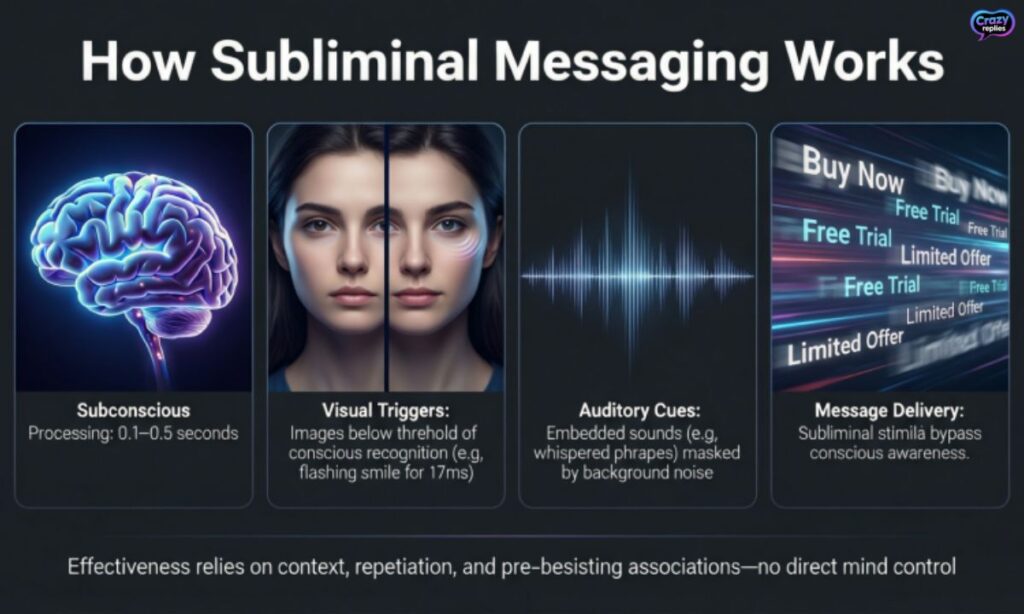
Subliminal messaging operates through carefully designed techniques that slip past your conscious filters. The process involves presenting stimuli so quickly or quietly that your conscious mind misses them entirely.
Understanding how subliminal messaging works helps explain why it remains controversial in media psychology. The mechanism relies on sensory perception limits and the brain’s ability to register information at unconscious levels.
The Subliminal Messaging Process
- Step 1: A message is embedded below the perceptual threshold where conscious detection is unlikely
- Step 2: Visual subliminal cues or audio subliminal messages are presented for milliseconds or at very low volumes
- Step 3: Your sensory organs receive the stimuli even though you don’t consciously notice them
- Step 4: The information undergoes unconscious processing in your subconscious mind
- Step 5: These hidden messages in media may trigger subtle psychological response triggers that influence behavior
Visual vs Audio Subliminal Techniques
| Visual Subliminal Messaging | Audio Subliminal Messaging |
| Frame flashing technique (1/3000 second) | Messages hidden below audio perception threshold |
| Hidden symbols in logos and images | Backmasking technique in music |
| Negative space design in advertising | Low-volume affirmations under music |
| Quick image insertions in video | High or low frequency sound waves |
| Works through visual cognition pathways | Targets auditory processing systems |
An Early Attempt at Subliminal Messaging
The most famous example of subliminal messaging dates back to 1957 when marketer James Vicary claimed a groundbreaking experiment. He reported flashing hidden messages during a movie theater screening to test subliminal advertising effectiveness.
Vicary’s experiment became the foundation of subliminal persuasion research and sparked massive debate about psychological persuasion. Though later admitted as a hoax, this attempt shaped public perception of subliminal messaging for decades.
Key Facts of the 1957 Experiment
- The claim: Vicary said he flashed “Drink Coca-Cola” and “Eat Popcorn” messages for 1/3000th of a second during movies
- Reported results: He claimed Coke sales increased 18% and popcorn sales jumped 58% through this subliminal perception technique
- The truth revealed: In 1962, Vicary admitted the entire experiment was fabricated, yet the concept of subliminal messaging had already captured public imagination and raised serious ethical concerns in advertising
Subliminal Messaging in Advertising
Subliminal messaging has been a hot topic in advertising ethics for decades. Marketers have explored various psychological marketing tactics to influence consumer behavior without direct awareness.
Today’s subliminal advertising uses sophisticated neuromarketing techniques that go beyond simple frame flashing. These subtle persuasion methods aim to shape brand perception psychology and drive purchasing decisions through implicit communication.
Common Subliminal Methods in Advertising
- Hidden symbols in logos: Companies embed subtle imagery in their brand designs to create psychological associations
- Logo symbolism meaning: Brand marks carry implicit brand communication that triggers emotional responses
- Corporate visual messaging: Strategic use of colors, shapes, and negative space design to influence perception
- Implicit communication: Ads designed to work through cognitive priming rather than direct selling
- Hidden advertising techniques: Placement of products and messages that register below conscious awareness while affecting consumer behavior influence
| Advertising Type | Subliminal Technique Used |
| Print Advertising | Hidden symbols and negative space design in images |
| Video Commercials | Frame flashing technique and quick visual subliminal cues |
| Audio Ads | Background audio subliminal messages below perception threshold |
| Logo Design | Symbolic imagery and implicit brand communication |
| Product Placement | Unconscious processing through repeated subtle exposure |
Hidden Messages in Corporate Logos

Corporate logos often contain clever hidden messages in media that work as a form of subliminal messaging. These designs use logo symbolism meaning and negative space design to communicate brand values at subconscious levels.
Famous Logo Examples with Hidden Elements
- FedEx arrow: The negative space between the ‘E’ and ‘x’ forms an arrow, subtly suggesting speed and forward movement through visual subliminal cues
- Amazon smile: The arrow from ‘A’ to ‘Z’ represents everything available while forming a smile, creating positive psychological associations
- Toblerone bear: A hidden bear in the mountain design connects to the chocolate’s Swiss heritage through implicit brand communication
- Baskin-Robbins 31: The pink ‘BR’ cleverly forms the number 31, representing their original 31 flavors using corporate visual messaging
Brand Logos and Their Hidden Meanings
| Brand | Hidden Meaning in Design |
| FedEx | Arrow symbolizing speed and precision delivery |
| Amazon | A to Z arrow representing complete selection |
| Toblerone | Bear shape honoring Bern, Switzerland origins |
| Baskin-Robbins | Number 31 embedded in the initials |
| Coca-Cola | Danish flag in the ‘O’ appeals to Danish market |
Subliminal Messaging in Media and Popular Culture
Subliminal messaging appears across various forms of entertainment and media, sparking endless conspiracy theories and debates. From movies to music, people claim to find hidden messages that influence audiences through subconscious influence.
The psychological impact of media extends beyond entertainment into political campaigns and propaganda techniques. Whether real or imagined, these claims highlight public concerns about behavioral manipulation debate and media effects theory.
Subliminal Messaging Across Media Forms
- Movies and TV: Alleged frame flashing technique in films and quick visual subliminal cues inserted into scenes to influence viewer emotions and attention and perception
- Music industry: Claims of backmasking technique where reversed messages hide in songs, plus audio subliminal messages embedded beneath musical tracks
- Political campaigns: Use of psychological persuasion through carefully crafted imagery, symbolic imagery, and persuasive communication strategies that target subconscious decision-making
- Television advertising: Networks accused of using hidden advertising techniques and perceptual threshold manipulation to boost consumer behavior influence during commercial breaks
Subliminal Messages Examples
Real-world examples of subliminal messaging range from documented cases to disputed claims that fuel ongoing debates. These instances show how subliminal perception techniques have been attempted across different industries and platforms.
Understanding actual subliminal messaging examples helps separate fact from fiction in media psychology. While some are proven instances of psychological marketing tactics, others remain controversial and unverified.
Real-World Subliminal Messaging Examples
- Disney movies: Alleged hidden symbols and quick frames inserted in animated films, though Disney denies intentional subliminal advertising
- Marlboro racing: Red and white Formula One cars that maintained brand colors after cigarette advertising bans, using implicit communication
- McDonald’s speed signs: Golden arches allegedly placed near speed limit signs to create subconscious associations through cognitive priming
- KFC dollar bills: Claims of hidden imagery in their ads designed to trigger consumer behavior influence
- Political debate backgrounds: Strategic use of colors and symbolic imagery during campaigns as persuasive communication strategies
- Retail store music: Tempo and audio subliminal messages designed to influence shopping pace and subconscious decision-making
Subliminal Messaging in Action
| Example | Medium | Purpose |
| Movie theater popcorn flashes | Film/Video | Increase concession sales through visual subliminal cues |
| Backmasking in rock music | Audio/Music | Alleged hidden messages (mostly debunked) |
| Logo hidden symbols | Print/Branding | Build brand perception psychology subconsciously |
| Store background music tempo | Retail Audio | Control shopping speed and purchasing behavior |
| Political ad imagery | TV/Digital | Influence voter perception through psychological persuasion |
| Product placement repetition | Movies/TV | Create unconscious processing and brand familiarity |
Scientific Research and Effectiveness of Subliminal Messages
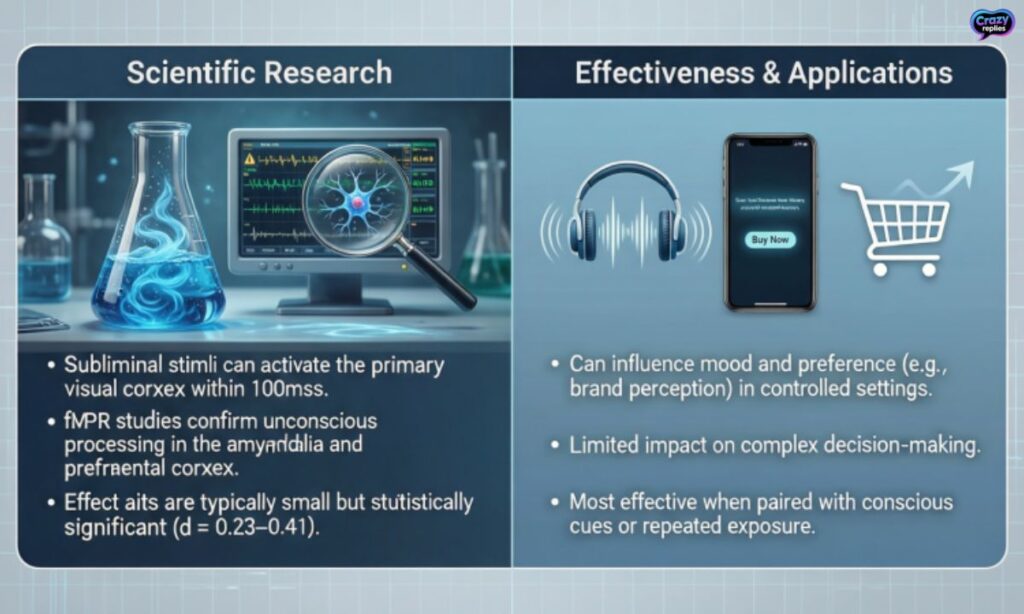
Scientific research on subliminal messaging shows mixed results. Most studies confirm subliminal perception exists, but its real power is much weaker than people think.
Research proves that subliminal messages create only brief effects. They don’t cause strong behavioral manipulation or lasting changes in consumer behavior influence like many fear.
Key Research Findings on Subliminal Messaging
- Limited impact: Unconscious processing happens, but subliminal messaging doesn’t control behavior like myths suggest
- Context matters: Subliminal perception only works when messages match what you already want or need
- Threshold issues: The perceptual threshold differs for everyone, making consistent subliminal advertising nearly impossible
- Temporary effects: Any cognitive priming from nonconscious stimuli fades fast and creates no lasting psychological conditioning
Major Subliminal Messaging Studies
| Study | Result | Conclusion |
| Vicary 1957 (debunked) | Claimed 18% sales increase | Fake data; no real effect |
| Karremans 2006 | Thirsty people chose primed brand | Works only with existing need |
| Pratkanis 1992 | No persuasion evidence found | Subliminal messaging mostly fails |
| Dijksterhuis 2005 | Brief attention changes seen | Minor effects, no behavior shift |
| Greenwald 1991 | Self-help tapes failed | Placebo beat subliminal influence |
Ethical Concerns and Controversies of Subliminal Messaging
Subliminal messaging raises serious questions about advertising ethics and psychological manipulation. The debate centers on whether it’s acceptable to influence people without their conscious awareness or consent.
Critics argue that subliminal advertising violates basic principles of persuasion ethics and consumer rights. Even if effectiveness is limited, the intent to bypass conscious thought creates ethical concerns in advertising.
Major Ethical Issues with Subliminal Messaging
- Consent violation: Using hidden messages in media denies people the right to consciously evaluate persuasive communication strategies
- Manipulation concerns: Subliminal perception techniques attempt psychological persuasion without transparency or consumer awareness
- Vulnerable populations: Children and others may be especially susceptible to subconscious influence and implicit bias formation
- Deceptive practices: Hidden advertising techniques contradict honest marketing principles and undermine trust in media psychology
- Freedom of choice: Subliminal messaging threatens autonomous subconscious decision-making by using propaganda techniques without disclosure
Subliminal Messaging: Pros vs Cons
| Potential Pros | Ethical Cons |
| Could reduce clutter in advertising | Violates informed consent principles |
| Might help positive behavior (quitting smoking) | Enables behavioral manipulation debate |
| Less intrusive than direct ads | Bypasses conscious evaluation and choice |
| Could work with existing desires | Raises serious advertising ethics questions |
| May enhance brand recall subtly | Creates unfair psychological influence in media |
Final Words
Subliminal messaging shows how the mind can notice things without us realizing it. Small hidden signals can sometimes shape thoughts and feelings in subtle ways.
Even though its power is debated, the idea remains fascinating. It reminds us to stay aware of the messages we see and hear every day.
Frequently Asked Questions
What is subliminal messaging?
Subliminal messaging is when hidden messages are shown or played so quickly or subtly that your conscious mind doesn’t notice them, but your brain still may.
Does subliminal messaging really work?
Some studies suggest it can influence thoughts slightly, but it does not control minds or force actions. Its effects are usually small and subtle.
Where is subliminal messaging used today?
Subliminal messaging appears in advertising, movies, music, and even logo designs to create certain feelings or associations.
Can subliminal messaging affect behavior?
It may influence mood or preferences for a short time, but it cannot make people do something against their will.
Is subliminal messaging legal?
Laws vary by country, but many advertising authorities discourage or restrict its use due to ethical concerns.
What are common examples of subliminal messaging?
Hidden words in ads, brief images in films, and symbols in logos are common examples people talk about.
Should I be worried about subliminal messaging?
Not really being aware of media messages is usually enough, as subliminal effects are limited and not powerful on their own.

Nate Wilder has 4 years of experience crafting witty, smart replies and writing about relationships. At CrazyReplies.com, he shares fun, clever, and heartwarming responses that make conversations more interesting and connections stronger.