

Have you ever wanted to make your friends laugh without hurting their feelings? These clean roasts for 9 year olds are silly, funny, and perfect for friendly fun.
Whether you’re at school, a birthday party, or hanging out at home, these kid-safe roasts keep everyone smiling. Enjoy clever jokes that are kind, easy to remember, and safe for every occasion.
What “Roasting” Means for Kids (And Why It Should Stay Clean)
Roasting is just playful teasing between friends. With Clean Roasts for 9 Year Olds, the goal is laughter, not hurt feelings.
For kids, a roast is a quick joke about something silly, not a personal attack. It’s a fun way to bond with friends and family.
Clean Roasts for 9 Year Olds work best when they stay light. The line ends the moment someone stops smiling.
Real roasting is about wit, not weakness. Kids learn to be quick and funny without being mean.
This kind of humor teaches kids how to handle teasing in a healthy way. It builds confidence instead of breaking it down.
Clean Roasts for 9 Year Olds should never target looks, family, or things a kid can’t change. The joke should hit a moment, not a person.
Good roasting has rules, even if they’re unspoken. Everyone understands it’s a game, not a fight.
When done right, Clean Roasts for 9 Year Olds bring kids closer. They laugh together instead of feeling left out.
- Keeps friendships strong instead of damaging them.
- Builds confidence rather than fear.
- Encourages funny comebacks for kids without cruelty.
- Teaches the difference between bullying vs roasting.
- Makes playground roasts safe and fun.
- Helps kids practice witty replies for kids.
- Supports respectful humor in group settings.
- Avoids comments about appearance or family.
- Keeps things school-safe and teacher-approved.
- Builds emotional resilience early on.
- Encourages silly jokes for kids instead of insults.
- Makes birthday party roasts more enjoyable.
- Reduces the risk of real arguments.
- Teaches kids to read the room.
- Strengthens sibling roasts without resentment.
- Promotes healthy banter among classmates.
- Helps kids understand positive teasing.
- Avoids turning jokes into bullying.
- Keeps humor age-appropriate jokes for their age group.
- Makes kid-friendly roasts something everyone enjoys.
| Aspect | Clean Roasts for 9 Year Olds | Bullying |
| Intent | Make everyone laugh | Hurt or embarrass someone |
| Target | A moment or situation | A person’s identity or flaws |
| Tone | Light and friendly | Mean and repeated |
| Reaction | Both kids laugh | One kid feels bad |
| Consent | Mutual, like a game | One-sided, unwanted |
| Outcome | Stronger friendship | Damaged trust |
Safety Rules Before You Use Any Roasts
Before trying any Clean Roasts for 9 Year Olds, it’s smart to set a few ground rules. Humor works best when everyone feels safe.
Not every kid reacts the same way to teasing. What’s funny to one child might upset another.
Clean Roasts for 9 Year Olds should always be used with friends, not strangers. Trust is what makes the joke land right.
A good rule is to know the kid before you roast them. Sensitive topics should always stay off-limits.
Clean Roasts for 9 Year Olds work best in a relaxed setting, like recess or a party. Timing matters just as much as the words.
If a kid looks upset, the joke should stop immediately. Reading body language is part of safe roasting.
Clean Roasts for 9 Year Olds should never repeat after someone asks to stop. Respecting limits keeps the fun going for everyone.
Adults supervising should listen for tone, not just words. A joke said with kindness sounds different from one said with malice.
Clean Roasts for 9 Year Olds work because they follow simple boundaries. Once those boundaries are clear, kids can joke freely.
Teaching kids these rules early helps them enjoy humor responsibly. It also helps them recognize when teasing has gone too far.
- Only roast people you know well.
- Avoid family, looks, or money topics.
- Stop right away if someone seems hurt.
- Keep the tone playful, not harsh.
- Use short roasts for kids, not long insults.
- Make sure both kids are laughing.
- Avoid repeating a joke that didn’t land well.
- Stick to clean funny jokes only.
- Never bring up past mistakes or secrets.
- Keep volume and tone friendly.
- Use kid-safe humor in group settings.
- Avoid roasting in front of strangers.
- Save harsher jokes for close friends only.
- Don’t target physical features.
- Watch for signs of discomfort.
- Make sure it stays school-safe.
- Avoid roasts about grades or intelligence.
- Keep things teacher-approved when at school.
- Always allow a “stop” signal.
- Practice friendly teasing, not put-downs.
- Avoid public humiliation at all costs.
- Use playful insults sparingly.
- Check in after the joke if unsure.
- Remind kids it’s okay to say “not funny.”
- End the roast battle if tension rises.
| Situation | Safe for Clean Roasts for 9 Year Olds | Unsafe for Roasting |
| Close friends joking | Yes | — |
| Roasting a stranger | No | Yes (avoid) |
| Joking about hobbies | Yes | — |
| Joking about family issues | No | Yes (avoid) |
| Birthday party with friends | Yes | — |
| Roasting after someone says stop | No | Yes (avoid) |
| Classroom with teacher present | Yes, if school-safe | — |
| Targeting appearance | No | Yes (avoid) |
Roasts by Situation (So Kids Always Use the Right One)
The right Clean Roasts for 9 Year Olds depend on where and when they’re used. A joke that works at home might not work at school.
Picking the right situation makes a roast land better. It also keeps things kid-safe and friendly.
School-safe roasts need to stay light and quick. Teachers appreciate humor that doesn’t disrupt class.
Clean Roasts for 9 Year Olds at birthday parties can be a bit bolder. Friends usually expect more playful teasing at a celebration.
Sibling roasts work differently since family bonds allow more comfort. Still, the goal stays the same: laughter, not tears.
Gaming roasts for kids fit perfectly during video game sessions. They turn friendly competition into something funnier.
Sports roasts work great on the field or court. They add energy without ruining good sportsmanship.
Knowing when to use Clean Roasts for 9 Year Olds helps kids avoid awkward moments. The right timing makes every joke land smoothly.
- Use short roasts for kids during quick hallway chats.
- Save playground roasts for recess time only.
- Try birthday party roasts when the mood is already festive.
- Use sibling roasts only at home, not in public.
- Pick gaming roasts for kids during multiplayer matches.
- Use sports roasts after a friendly game, not during one.
- Try funny classroom jokes only when teachers allow it.
- Use school-safe roasts before or after class, not during lessons.
- Save cartoon-style roasts for fans of the same show.
- Use superhero roasts when friends share the same favorite hero.
- Try funny homework jokes when work feels stressful.
- Use silly school jokes to lighten group projects.
- Save clean roast battle lines for organized, fun contests.
- Use funny best friend roasts only with close friends.
- Try clean comebacks when someone roasts you first.
- Use witty replies for kids to keep a joke chain going.
- Save funny one-liner roasts for quick exchanges.
- Use clean roast ideas that match the event’s energy.
- Try age-appropriate jokes depending on who’s listening.
- Use clean roast templates as a starting point, then adjust.
| Setting | Best Roast Style | Example Use |
| Classroom | School-safe, short roasts for kids | Quick joke before class starts |
| Playground | Playground roasts, friendly teasing | During recess games |
| Birthday party | Birthday party roasts, bold but kind | Party games or cake time |
| Home with siblings | Sibling roasts, comfortable teasing | After dinner banter |
| Video gaming | Gaming roasts for kids | During multiplayer rounds |
| Sports practice | Sports roasts, light competition | After a friendly match |
| Situation | Example Roast |
| Classroom | “You finished your homework so fast, did you even read the questions?” |
| Playground | “You run so slow, even the slide beats you to the bottom.” |
| Birthday party | “You blew out the candles, but not your bad dance moves.” |
| Sibling teasing | “You borrow my stuff so much, you should pay rent.” |
| Gaming | “You respawn so much, the game thinks it’s your second home.” |
| Sports | “You missed that shot so wide, the ball needed its own GPS.” |
Kid Comebacks (Clean Replies When Someone Roasts You)
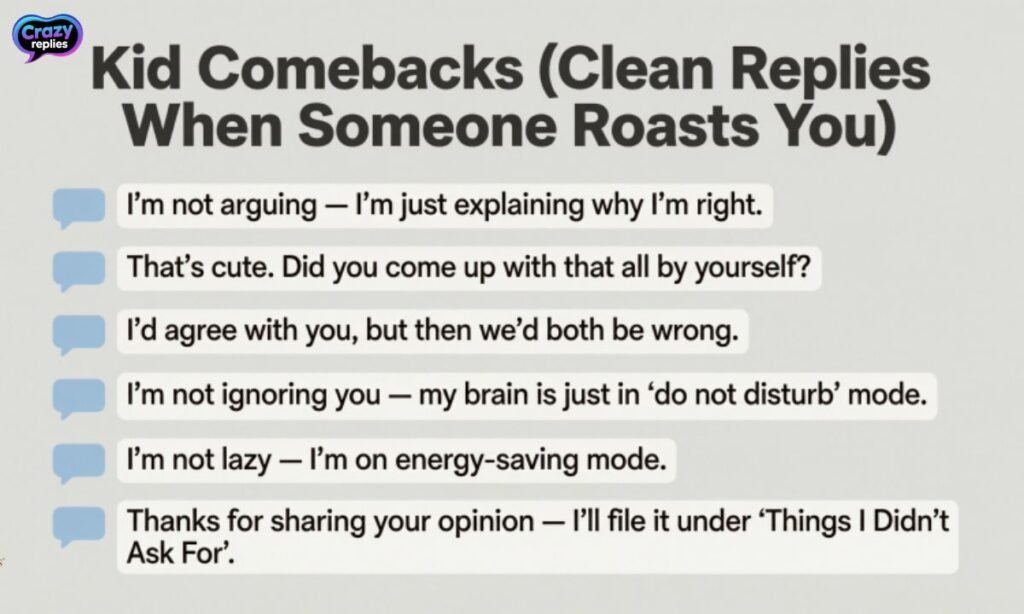
Knowing how to respond matters as much as Clean Roasts for 9 Year Olds themselves. A good comeback keeps the joke going without hurting anyone.
Clean comebacks show confidence. They tell friends a kid can take a joke and give one right back.
Funny comebacks for kids work best when they’re quick. A delayed reply loses the humor.
Clean Roasts for 9 Year Olds are only half the fun, the comeback is the other half. Together, they create healthy banter between friends.
Witty replies for kids don’t need to be harsh. A clever twist is usually enough to win the exchange.
Kids who master comebacks handle teasing better overall. It builds quick thinking and emotional confidence.
Clean Roasts for 9 Year Olds pair naturally with smart comebacks. The back-and-forth is what makes roast battles fun, not painful.
Practicing comebacks ahead of time helps kids stay calm under pressure. It turns teasing into a game instead of a threat.
- Keep your comeback short and simple.
- Smile when you respond, it shows confidence.
- Use clean comebacks instead of insults.
- Turn the joke back around playfully.
- Stay calm, don’t take it personally.
- Use funny comebacks for kids that match the original joke.
- Practice a few witty replies for kids in advance.
- Avoid getting angry during a roast battle.
- Keep the tone light, not defensive.
- Use humor to redirect the joke.
- Try silly jokes for kids as quick comebacks.
- Don’t overthink your response, speed matters.
- Use playful insults only if the other kid started it.
- Match the energy of the original roast.
- Avoid personal attacks even in a comeback.
- Use clean roast lines as comeback templates.
- Keep things age-appropriate jokes at all times.
- Laugh along, even if the joke was on you.
- Use a confident tone, not a nervous one.
- Try funny one-liner roasts as fast replies.
- End with a smile to show it’s all in fun.
- Avoid bringing up sensitive topics in your reply.
- Use friendly teasing to keep the mood light.
- Practice with friends so it feels natural.
- Remember, the goal is laughter, not winning.
| Original Roast | Clean Comeback |
| “You’re so slow!” | “Slow and steady still beats you crying at the finish line.” |
| “Your drawing looks weird.” | “At least I tried, your handwriting looks like a spider attacked the page.” |
| “You lost again?” | “I’m just letting you win so you don’t cry.” |
| “You eat so much.” | “Growing brains need snacks, what’s your excuse?” |
| “Your shoes are untied.” | “At least my shoes match, unlike your jokes.” |
Make Your Own Kid-Safe Roasts (Easy Templates)
Sometimes the best Clean Roasts for 9 Year Olds are the ones kids create themselves. Templates make it easy to build new jokes fast.
A simple structure helps kids stay creative without crossing any lines. Once they learn the pattern, the jokes flow naturally.
Clean Roasts for 9 Year Olds usually follow a “setup and surprise” format. The first part sounds normal, then the ending flips it with humor.
Using clean roast templates means kids don’t have to start from scratch. They just fill in details about their friend or situation.
Clean Roasts for 9 Year Olds work best when they’re about actions, not appearance. A joke about being slow at a game is safer than a joke about looks.
Kids can practice by swapping small details in a template. This keeps the roast fresh every time it’s used.
Clean Roasts for 9 Year Olds also work well with comparisons. Comparing someone to something silly is an easy, safe formula.
Templates help kids understand structure before adding their own twist. Over time, they’ll create funny roast lines without even thinking about it.
Clean Roasts for 9 Year Olds become more fun once kids personalize them. A joke made just for a friend always lands better.
With practice, building your own roast becomes second nature. It’s one of the best ways to keep humor fresh and kind.
- “You’re so [funny trait], even [silly comparison] couldn’t keep up.”
- “I’ve seen [common kid activity] done better by [funny comparison].”
- “Your [hobby] skills are so [exaggerated word], even a [silly object] is impressed.”
- “You’re not slow, you just move at [funny comparison] speed.”
- “Your [game] skills called, they want a refund.”
- “You’re so competitive, even [silly object] gave up trying.”
- “Your homework excuse is more creative than your actual homework.”
- “You walk so loud, even the floor complains.”
- “Your jokes are so old, even your grandparents heard them first.”
- “You’re not bad at sports, you’re just really good at watching.”
- Start with something true and harmless.
- Add a funny exaggeration.
- Compare it to something silly or unexpected.
- Keep the wording short and clear.
- Avoid personal or sensitive topics.
- Test it on a close friend first.
- Adjust the wording if it feels too harsh.
- Use a playful tone, not a mean one.
- Stick to clean funny jokes as your base.
- Make sure both kids would laugh at it.
- Use age-appropriate jokes for the audience.
- Keep the punchline at the very end.
- Practice timing so it lands well.
- Avoid copying roasts word-for-word, add your twist.
- Use kid-friendly roasts as your safety check.
- Save your favorite lines for future use.
- Mix and match templates for variety.
- Use silly comparisons kids will recognize.
- Keep it school-safe if used at school.
- Always end with a smile or laugh.
| Template | Finished Clean Roast |
| “You’re so [trait], even [comparison] couldn’t keep up.” | “You’re so slow, even a turtle could lap you.” |
| “Your [hobby] skills called, they want a refund.” | “Your soccer skills called, they want a refund.” |
| “You walk so loud, even the floor complains.” | “You walk so loud, even the floor asked you to chill.” |
| Safe Topic | Why It Works |
| Gaming skills | Light, common ground for most kids |
| Sports performance | Easy to joke about without being personal |
| Homework habits | Relatable and harmless |
| Silly habits (loud walking, snacking) | Everyday actions, not personal traits |
| Cartoon or superhero comparisons | Fun and imaginative, not hurtful |
Bonus: Roast Games for 9-Year-Olds (Classroom & Home)
Turning Clean Roasts for 9 Year Olds into a game makes them even more fun. Games add structure and keep things fair for everyone.
A roast game gives kids clear turns and rules. This keeps the humor friendly instead of one-sided.
Clean Roasts for 9 Year Olds work great in a classroom setting when teachers set simple limits. A short, supervised game keeps everyone smiling.
At home, siblings can turn roasting into a fun family activity. It’s a great way to bond after dinner or during game night.
Clean Roasts for 9 Year Olds fit perfectly into party games too. Adding a timer or scorecard makes it feel like a real contest.
Roast games also teach kids patience and turn-taking. Everyone gets a chance to joke and a chance to laugh.
Clean Roasts for 9 Year Olds become more exciting with simple rules in place. Structure keeps the game fair and stops things from getting too intense.
These games are a fun bonus to any party, classroom activity, or family night. They turn humor into a shared, positive experience.
- Set a timer for each kid’s turn.
- Allow only one roast per turn.
- Use short roasts for kids to keep pace quick.
- Let the teacher approve jokes beforehand.
- Keep the game school-safe at all times.
- Use a “respect card” if a joke goes too far.
- Reward the funniest, not the meanest, joke.
- Use funny classroom jokes as a warm-up round.
- Let kids vote on their favorite roast.
- Keep the tone playful, not competitive.
- Use clean funny jokes as examples first.
- Set a “no repeats” rule for fairness.
- Allow comebacks right after each roast.
- Use teacher-approved jokes as a reference list.
- End the game with a group laugh, not a winner.
- Set up a mini roast battle with siblings.
- Use a “best comeback” scoring system.
- Let parents judge the funniest line.
- Use sibling roasts as the main theme.
- Add a silly prize for the winner.
- Use birthday party roasts during celebrations.
- Try a “roast and reply” round format.
- Use gaming roasts for kids during game nights.
- Add sports roasts after a backyard match.
- Use a timer to keep turns fair.
- Let everyone vote for the funniest joke.
- Use clean roast battle rules to avoid hurt feelings.
- Add a “stop” word if things feel too much.
- Use funny one-liner roasts for quick rounds.
- Mix in funny best friend roasts when friends visit.
- End with a group high-five, win or lose.
- Use clean roast ideas from a printed list for beginners.
- Let kids create their own clean roast templates.
- Keep score on paper for added fun.
- Always end the game on a positive note.
| Element | Classroom Version | Home Version |
| Turn limit | One roast per turn | One roast or comeback per turn |
| Time limit | 10–15 seconds | 15–20 seconds |
| Supervision | Teacher-approved jokes only | Parent or older sibling judges |
| Scoring | Group vote for funniest | Points for best comeback |
| Stop signal | Respect card | “Stop” word |
| Goal | Laughter, not winning | Fun family bonding |
How to Teach Kids Healthy Banter
Teaching kids healthy banter starts with good examples. Clean Roasts for 9 Year Olds are a great way to introduce this skill early.
Kids learn humor by watching adults and friends. Showing them respectful humor helps them copy the right habits.
Clean Roasts for 9 Year Olds work as a teaching tool when paired with clear explanations. Kids need to understand why the joke is funny, not hurtful.
Parents and teachers can guide kids by setting examples first. Demonstrating a clean roast shows kids exactly what’s acceptable.
Clean Roasts for 9 Year Olds also teach empathy alongside humor. Kids learn to notice when a joke isn’t landing well.
Practicing with trusted adults builds confidence before kids try it with friends. This makes the transition to peer banter smoother.
Clean Roasts for 9 Year Olds should always come with a lesson about boundaries. Healthy banter only works when both sides enjoy it.
Over time, kids naturally pick up the rhythm of teasing without guidance. That’s when healthy banter becomes second nature.
- Start with simple, silly jokes for kids.
- Explain the difference between bullying vs roasting.
- Use clean funny jokes as everyday examples.
- Model respectful humor in daily conversations.
- Encourage kids to ask before roasting a new friend.
- Teach kids to read facial expressions during jokes.
- Use age-appropriate jokes for the child’s age group.
- Explain why looks and family are off-limits.
- Show kids how to apologize if a joke goes wrong.
- Practice clean comebacks together at home.
- Use kid-friendly roasts as practice examples.
- Reinforce that laughter should be shared, not one-sided.
- Teach kids to stop immediately if asked.
- Use harmless teasing to build early confidence.
- Explain that tone matters as much as words.
- Encourage kids to roast actions, not identities.
- Use funny comebacks for kids to balance the exchange.
- Remind kids that friends should feel safe, not scared.
- Teach kids to recognize discomfort in others.
- Use clean roast lines as positive examples.
- Praise kids when they handle teasing well.
- Correct gently if a joke crosses a line.
- Use school-safe roasts as classroom examples.
- Explain the value of friendly teasing over insults.
- Teach kids it’s okay to say “that’s not funny.”
- Use witty replies for kids to build quick thinking.
- Encourage humor that includes everyone, not excludes.
- Use teacher-approved jokes as a safe starting point.
- Remind kids that healthy banter goes both ways.
- Teach patience, not every joke lands the first time.
- Use sibling roasts to practice in a safe space.
- Explain that consent matters, even in jokes.
- Reinforce kindness as the foundation of humor.
- Use positive teasing to build trust between friends.
- Teach kids to laugh at themselves sometimes too.
- Use clean roast templates to guide early attempts.
- Explain that timing affects how a joke lands.
- Encourage kids to check in after a joke.
- Use funny things to say to friends as low-pressure practice.
- Remind kids the goal is connection, not competition.
| Sign | Healthy Banter | Harmful Teasing |
| Reaction | Both kids laugh | One kid feels upset |
| Frequency | Occasional, balanced | Repeated, one-sided |
| Topic | Actions or habits | Identity or appearance |
| Consent | Mutual and welcomed | Unwanted, ignored requests to stop |
| Tone | Light and warm | Cold or mocking |
| Outcome | Stronger friendship | Hurt feelings, distance |
Common Mistakes Kids Should Avoid While Roasting
Even with good intentions, mistakes happen during Clean Roasts for 9 Year Olds. Knowing what to avoid keeps the fun going for everyone.
Some jokes seem harmless but can hurt without warning. Learning common mistakes helps kids stay on the safe side.
Clean Roasts for 9 Year Olds can go wrong when kids ignore reactions. Watching how a friend responds matters more than the joke itself.
Repeating a roast too many times turns a joke into bullying. Clean Roasts for 9 Year Olds should always feel fresh, not repetitive.
Picking the wrong audience is another common mistake. A joke that works with close friends may not work with strangers.
Clean Roasts for 9 Year Olds lose their charm when they target sensitive topics. Family, looks, and personal struggles should always stay off-limits.
Timing mistakes can also ruin a good joke. Clean Roasts for 9 Year Olds work best in relaxed, happy moments, not stressful ones.
Avoiding these common mistakes helps kids enjoy roasting without regret. A little awareness goes a long way in keeping humor kind.
- Roasting someone you don’t know well.
- Targeting looks or physical features.
- Bringing up family problems in a joke.
- Repeating a roast after being asked to stop.
- Roasting in front of strangers.
- Ignoring a friend’s upset reaction.
- Using playful insults too harshly.
- Forgetting to check the other person’s mood.
- Roasting during a stressful moment.
- Making jokes about grades or intelligence.
- Using sibling roasts in public settings.
- Mocking someone’s personal struggles.
- Copying mean jokes instead of clean roast lines.
- Roasting without allowing a comeback.
- Using sarcasm that’s hard to understand.
- Forgetting humor should go both ways.
- Roasting a topic someone is sensitive about.
- Using harsh tone instead of a playful one.
- Ignoring teacher rules during school-safe roasts.
- Skipping the “stop” signal when asked.
- Roasting too many times in a row.
- Using inside jokes that exclude others.
- Forgetting to laugh along if roasted back.
- Making the joke too long or complicated.
- Avoiding short roasts for kids in favor of long insults.
- Roasting during birthday party roasts when someone feels left out.
- Using playground roasts to embarrass, not entertain.
- Forgetting clean comebacks should stay light too.
- Roasting without reading body language first.
- Using funny one-liner roasts in the wrong setting.
- Mixing real criticism into a joke.
- Ignoring how loud or public the moment is.
- Using clean roast templates word-for-word without adjusting tone.
- Forgetting that healthy banter needs balance.
- Roasting someone already having a bad day.
| Common Mistake | Better Approach for Clean Roasts for 9 Year Olds |
| Roasting a stranger | Stick to close friends only |
| Targeting appearance | Joke about actions or habits instead |
| Repeating after “stop” | End the joke immediately |
| Roasting during stress | Wait for a relaxed, happy moment |
| Copying harsh jokes | Use clean funny jokes as a base |
| Ignoring reactions | Watch for laughter before continuing |
When a Roast Crosses the Line into Bullying
Even with Clean Roasts for 9 Year Olds, lines can blur if kids aren’t careful. Knowing where roasting ends and bullying begins keeps everyone safe.
A roast is meant to make both people laugh. Bullying only makes one person feel small.
Clean Roasts for 9 Year Olds stop being clean the moment they’re repeated against someone’s wishes. That’s when humor turns into harm.
Bullying vs roasting is an important lesson for every kid. The difference often comes down to intent and reaction.
Clean Roasts for 9 Year Olds always involve mutual enjoyment. If only one side is laughing, something has gone wrong.
A joke aimed at the same person again and again isn’t roasting anymore. It becomes targeted teasing, which is a form of bullying.
Clean Roasts for 9 Year Olds should never make a child feel isolated or scared. If that happens, it’s time to stop completely.
Watching for these warning signs helps adults step in early. Catching the shift before it grows is key.
Clean Roasts for 9 Year Olds rely on trust between friends. Once that trust breaks, the joke has crossed a line.
Teaching kids to recognize this difference protects everyone involved. It keeps humor fun instead of hurtful.
- The same person is targeted repeatedly.
- One kid stops laughing or smiling.
- The joke continues after being asked to stop.
- The target seems isolated from the group.
- Comments shift from actions to personal flaws.
- The tone turns harsh instead of playful.
- Friends start avoiding the roasting kid.
- The joke is said with a mean expression.
- The target seems nervous before interactions.
- Comments focus on family or home life.
- The roast happens in front of a large crowd.
- The target tries to change the subject.
- Jokes start mocking instead of teasing.
- The same weakness is brought up often.
- The target seems sad afterward.
- Comebacks are no longer allowed.
- The joke is used to exclude someone from play.
- Body language shows discomfort, not amusement.
- The roast happens even after tears.
- Friends laugh, but the target doesn’t.
- The target avoids certain people or places.
- Jokes are shared online to embarrass someone.
- The same group always targets one kid.
- Comments focus on things the child can’t change.
- The roast feels planned, not spontaneous.
- The target stops speaking up for themselves.
- Adults notice a pattern, not a one-time joke.
- The joke references private information.
- The roasting kid ignores clear discomfort.
- The target seems anxious before group activities.
| Sign | Clean Roasts for 9 Year Olds | Bullying |
| Frequency | Occasional | Repeated, targeted |
| Reaction | Mutual laughter | One-sided distress |
| Stops when asked | Yes | No |
| Topic | Actions, habits | Identity, flaws |
| Setting | Friendly, equal group | Power imbalance |
| Effect over time | Stronger bond | Isolation, fear |
| Step | Action |
| Notice | Watch for changes in mood or behavior |
| Pause | Stop the joke immediately |
| Talk | Ask the child how they feel |
| Explain | Remind kids about bullying vs roasting |
| Support | Comfort the child who felt hurt |
| Guide | Redirect toward respectful humor next time |
Best Clean Roasts for Different Ages (8, 9, 10 & 11-Year-Olds)
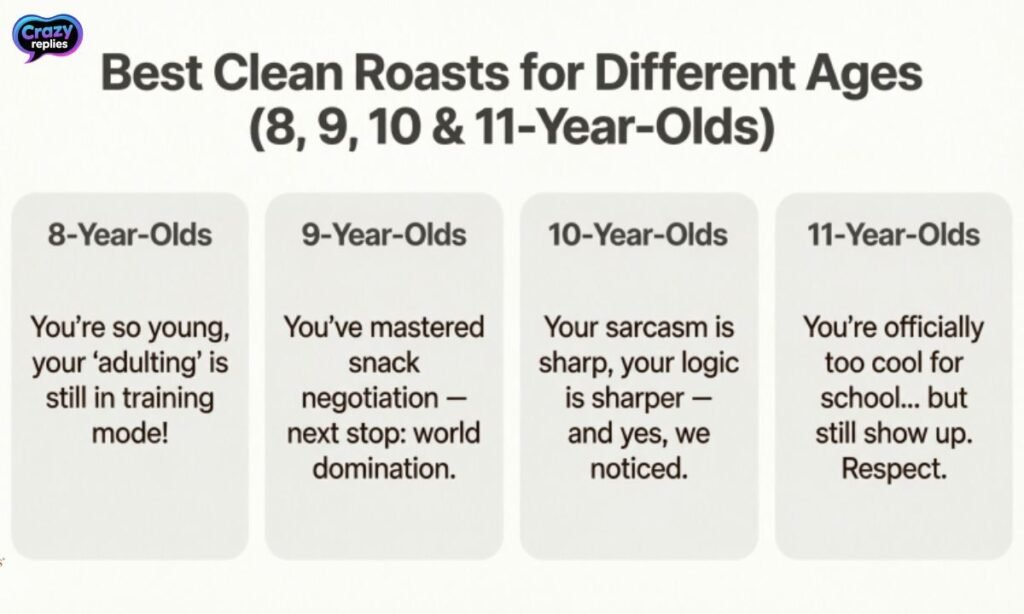
Clean Roasts for 9 Year Olds don’t always work the same way for other ages. Younger and older kids understand humor a little differently.
Age-appropriate jokes matter because kids grow fast between 8 and 11. A joke that lands at 9 might feel too simple at 11.
Clean Roasts for 9 Year Olds usually focus on simple comparisons and silly exaggerations. This age group enjoys quick, easy-to-understand humor.
Eight-year-olds prefer gentler, sillier jokes. Their humor leans more toward goofy than clever.
Clean Roasts for 9 Year Olds sit right in the middle, combining silliness with a bit more wit. This is often the sweet spot for playful teasing.
Ten and eleven-year-olds start understanding sarcasm and wordplay better. Their jokes can be slightly sharper while staying kind.
Clean Roasts for 9 Year Olds work as a great starting point for teaching age-appropriate humor. Kids can grow into more advanced jokes over time.
Matching roasts to age keeps humor relatable and effective. It also makes sure every joke gets the right reaction.
- “You run so funny, even ducks look graceful next to you.”
- “Your drawing has more scribbles than a toddler’s notebook.”
- “You eat so slow, snails send you sympathy cards.”
- “Your shoes squeak louder than your singing voice.”
- “You lose your pencil so much, it needs its own GPS.”
- “Your jokes are so silly, even your stuffed animals laugh.”
- “You trip so much, gravity loves picking on you.”
- “Your hair looks like it lost a fight with the wind.”
- “You’re so messy, your room needs its own zip code.”
- “Your dance moves look like a confused robot.”
- “You’re so competitive, even board games stress you out.”
- “Your homework excuses deserve their own award show.”
- “You walk so loud, the whole house knows you’re coming.”
- “Your gaming skills called, they want a rematch.”
- “You’re so picky, even pizza has rules with you.”
- “Your jokes are funny, but your timing needs work.”
- “You run from chores faster than from tag.”
- “Your room looks like a tornado visited for fun.”
- “You talk so fast, even auto-captions can’t keep up.”
- “Your snack stash could feed a small classroom.”
- “Your sarcasm level is higher than your bedtime negotiations.”
- “You’re so dramatic, school plays should hire you.”
- “Your texting speed is faster than your homework speed.”
- “You’re so competitive, even checkers feels intense with you.”
- “Your playlist has more drama than a soap opera.”
- “You’re late so often, clocks avoid you.”
- “Your comebacks are sharp, but your chores list isn’t done.”
- “You argue so well, lawyers might take notes.”
- “Your gaming rage could power a small city.”
- “Your fashion sense changes faster than the weather.”
- “Your sarcasm is so strong, it needs a warning label.”
- “You’re so confident, even mirrors ask for advice.”
- “Your group chat replies are slower than dial-up internet.”
- “Your debate skills could win arguments with a wall.”
- “You’re so dramatic, Oscars should consider you.”
- “Your homework procrastination deserves a trophy.”
- “Your jokes are sharp, but your room is a disaster zone.”
- “You’re so picky with shows, streaming services fear you.”
- “Your sleep schedule confuses even your alarm clock.”
- “Your sarcasm could outshine a stand-up comedian.”
| Age | Roast Style | Example Topics |
| 8 years | Silly, gentle, exaggerated | Clumsiness, messiness, simple habits |
| 9 years | Balanced wit and silliness | Gaming, homework, competitiveness |
| 10 years | Slightly sharper, more sarcasm | Chores, fashion, drama |
| 11 years | Clever wordplay, confident tone | Sarcasm, debates, procrastination |
| Age Group | Humor Level | Best Fit |
| 8-Year-Olds | Very simple, silly | Beginner humor |
| 9-Year-Olds | Balanced, witty, fun | Clean Roasts for 9 Year Olds sweet spot |
| 10–11-Year-Olds | Sharper, sarcastic | Advanced humor |
Parent & Teacher Tips for Encouraging Respectful Humor
Adults play a big role in how kids use Clean Roasts for 9 Year Olds. Guidance from parents and teachers shapes healthy habits early.
Setting clear expectations helps kids understand boundaries. Respectful humor grows naturally when adults model it well.
Clean Roasts for 9 Year Olds work best when parents stay involved without controlling every joke. A light touch keeps kids comfortable being themselves.
Teachers can use classroom moments to teach humor responsibly. A quick lesson on tone can prevent bigger issues later.
Clean Roasts for 9 Year Olds become a great teaching tool when adults explain the “why” behind the rules. Kids listen better when they understand reasons, not just limits.
Encouraging open conversations helps kids feel safe sharing when a joke goes wrong. This builds trust between kids and adults.
Clean Roasts for 9 Year Olds should always be supported with consistent guidance at home and school. Mixed messages confuse kids about what’s acceptable.
With the right support, kids learn to balance humor and kindness naturally. That balance stays with them well beyond childhood.
- Model clean comebacks during family conversations.
- Praise kids for using kind, funny jokes.
- Set clear rules about off-limit topics.
- Encourage sibling roasts only in playful settings.
- Step in if teasing turns one-sided.
- Explain bullying vs roasting using real examples.
- Use family game nights to practice healthy banter.
- Encourage kids to ask before roasting new friends.
- Reinforce that stopping when asked is non-negotiable.
- Celebrate witty replies for kids instead of mean ones.
- Allow short, supervised roast games in class.
- Keep all jokes school-safe and teacher-approved.
- Set a timer to keep turns fair and quick.
- Encourage funny classroom jokes during breaks, not lessons.
- Use group discussions to explain respectful humor.
- Watch for signs a joke isn’t landing well.
- Reward kindness alongside humor in the classroom.
- Use real examples to highlight bullying vs roasting.
- Create a “stop” signal for classroom roast games.
- Encourage kids to include everyone in the fun.
- Use Clean Roasts for 9 Year Olds as teaching examples.
- Explain why certain topics stay off-limits.
- Encourage kids to read reactions before continuing.
- Reinforce that humor should never replace kindness.
- Praise kids who handle teasing gracefully.
- Use clean roast templates to guide early practice.
- Talk openly about feelings after a joke misfires.
- Remind kids that laughter should be shared, not forced.
- Keep communication open between home and school.
- Support kids in building confidence through respectful humor.
| Role | Focus Area | Example Action |
| Parent | Home behavior, family bonding | Modeling clean comebacks at dinner |
| Teacher | Classroom behavior, peer interaction | Supervising school-safe roast games |
| Both | Reinforcing respect and kindness | Explaining bullying vs roasting clearly |
| Both | Building confidence in kids | Encouraging Clean Roasts for 9 Year Olds as a positive activity |
What Makes a Roast Funny Instead of Rude
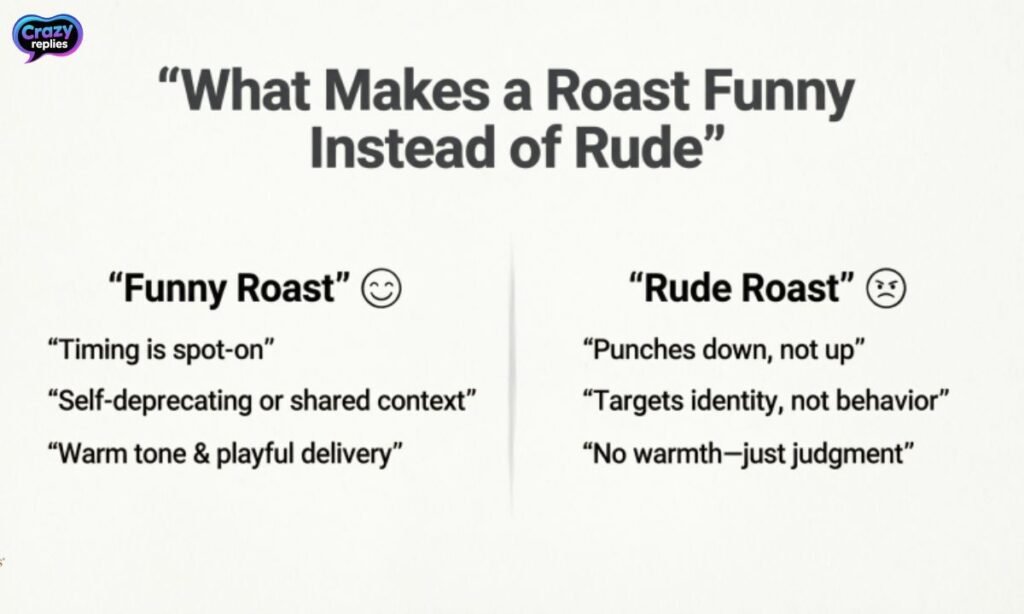
There’s a fine line between funny and rude, and Clean Roasts for 9 Year Olds always stay on the funny side. The trick is understanding what makes a joke work.
A funny roast surprises people. A rude one just hurts them.
Clean Roasts for 9 Year Olds rely on exaggeration, not cruelty. Stretching the truth in a silly way makes a joke land better than a harsh comment.
Timing also separates funny from rude. A joke told at the right moment feels playful, not awkward.
Clean Roasts for 9 Year Olds work because they target small, harmless things. Big or sensitive topics almost always tip a joke into rude territory.
Delivery matters just as much as the words. A friendly tone can turn an average joke into a great one.
Clean Roasts for 9 Year Olds succeed when both people are smiling by the end. If the laughter stops, the joke has gone too far.
Understanding this balance helps kids joke confidently without ever crossing a line. It’s a skill that gets better with practice.
- It uses harmless exaggeration.
- It targets a habit, not a person’s worth.
- It’s said with a smile.
- It surprises the listener in a clever way.
- It uses silly comparisons everyone understands.
- It stays short and quick.
- It fits the funny one-liner roasts style.
- It’s based on something true but small.
- It invites a comeback instead of silence.
- It feels like a game, not a judgment.
- It’s timed for a relaxed, happy moment.
- It avoids repeating the same joke too often.
- It uses friendly teasing instead of sharp criticism.
- It’s said between people who already trust each other.
- It matches the energy of the group.
- It leans on cartoon-style roasts or silly imagery.
- It keeps things kid-safe humor at its core.
- It ends with shared laughter, not silence.
- It uses clean funny jokes as its foundation.
- It avoids personal, sensitive subjects entirely.
- It targets appearance or things a kid can’t change.
- It’s repeated after someone asks to stop.
- It’s said with a harsh or angry tone.
- It singles out one person again and again.
- It brings up family or home struggles.
- It’s delivered to embarrass, not entertain.
- It ignores the other person’s reaction.
- It uses real criticism disguised as a joke.
- It happens in front of a large, judging crowd.
- It excludes someone instead of including them.
- It feels planned to hurt, not to play.
- It avoids giving the other person a chance to respond.
- It references private or sensitive information.
- It continues even after visible discomfort.
- It uses mocking instead of playful exaggeration.
- It’s said with a smirk meant to belittle.
- It crosses into bullying vs roasting territory.
- It leaves one person feeling small.
- It damages trust instead of building it.
- It turns a clean roast battle into a real conflict.
- It forgets that the goal is shared laughter.
- It ignores age-appropriate jokes guidelines.
- It abandons respectful humor for cheap shots.
- It skips the unwritten rules of kid-friendly roasts.
- It leaves no room for clean comebacks.
| Element | Funny Roast | Rude Comment |
| Target | Habit or action | Identity or appearance |
| Tone | Playful, warm | Harsh, mocking |
| Reaction | Shared laughter | Hurt or silence |
| Frequency | One-time, fresh | Repeated, targeted |
| Setting | Trusted friends | Any audience, no filter |
| Goal | Connection | Embarrassment |
| Question | If Yes | If No |
| Would both of us laugh? | Go ahead | Rethink the joke |
| Is it about a small habit? | Safe to use | Choose a different topic |
| Have I said this before and it upset them? | Don’t repeat it | Fine to try |
| Are we close friends? | Good context | Save it for later |
| Is the setting relaxed? | Good timing | Wait for a better moment |
Conclusion
Clean roasts for 9 year olds should always be fun, friendly, and respectful. A good joke makes everyone smile instead of hurting someone’s feelings.
Use these funny roasts to enjoy playful moments with friends, family, or classmates. Remember, the best roast is one that keeps everyone laughing together.
Frequently Asked Question
Are roasts for 9 year olds safe?
Yes, as long as they are clean, kind, and made to make everyone laugh. Avoid jokes about looks, family, or anything that could hurt someone’s feelings.
What are the best clean roasts for 9 year olds?
The best roasts are funny one-liners about silly habits, games, or everyday moments. They should be playful and never mean.
Can kids use roasts at school?
Yes, if the jokes are teacher-friendly and respectful. If someone feels upset, it’s always best to stop right away.
How do I make a funny roast without being rude?
Focus on funny situations, goofy mistakes, or playful habits instead of personal traits. A good roast makes everyone smile.
What should I do if someone gets hurt by a roast?
Say sorry, explain you were only joking, and don’t repeat the joke. Kindness is always more important than getting a laugh.
Can parents and teachers encourage clean roasting?
Absolutely! They can teach kids how to joke respectfully, know when to stop, and keep every roast friendly and fun.

Nate Wilder has 4 years of experience crafting witty, smart replies and writing about relationships. At CrazyReplies.com, he shares fun, clever, and heartwarming responses that make conversations more interesting and connections stronger.